
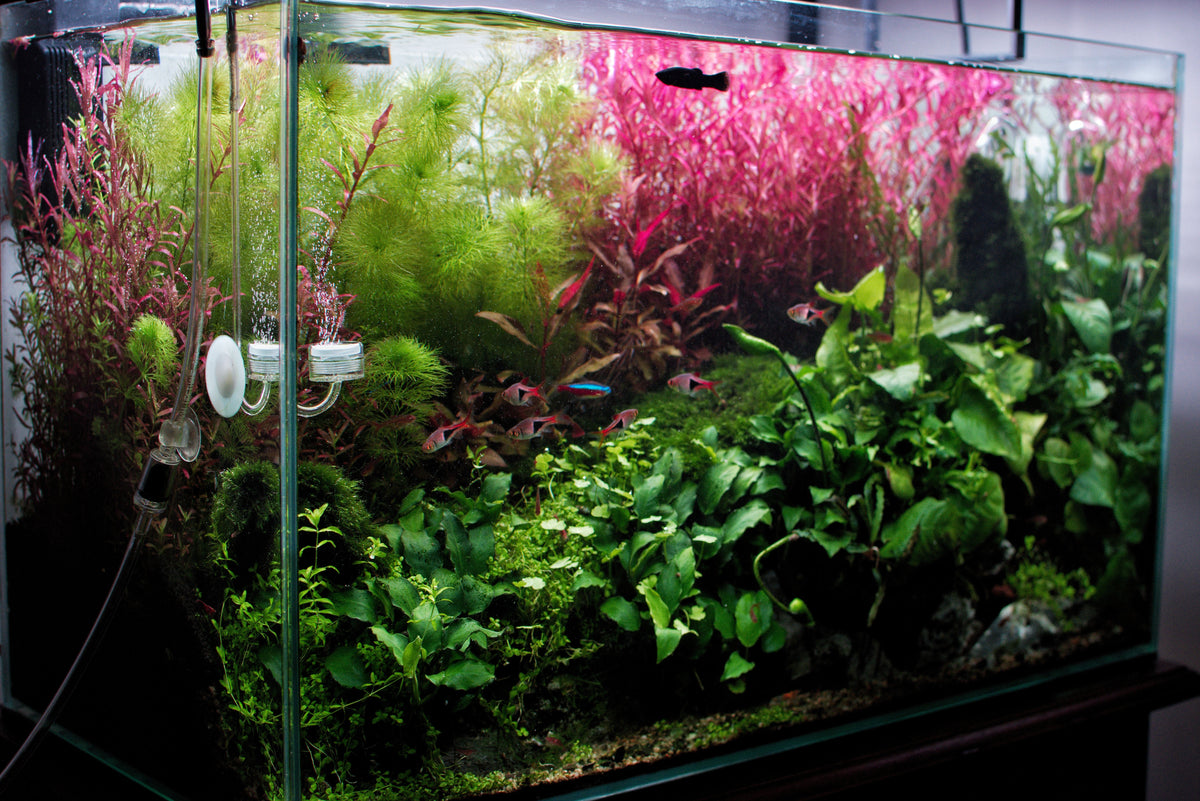
A CO2 diffuser breaks pressurised gas into a fine mist so it dissolves in the water instead of escaping at the surface. An inline diffuser sits outside the tank, in the outlet hose of an external canister filter; an in-tank diffuser mounts inside the aquarium. Both work the same way. The choice comes down to the filter you run and how much equipment you want to see.
What is a CO2 diffuser, and what is the difference between inline and in-tank?
Pressurised CO2 leaves the cylinder as gas, and gas that reaches the surface as a large bubble is gas the plants never use. A diffuser pushes it through a porous ceramic membrane first, which breaks it into a mist fine enough to stay in the water long enough to dissolve. Everything else — inline or in-tank, glass, acrylic or metal — is a question of where that happens and what it asks of your setup.
How a CO2 diffuser works
The gas arrives under pressure, meets the ceramic, and comes out the other side as mist. That only happens above the membrane's minimum working pressure of 30psi; below it the ceramic stays shut and you get bubbles at the counter with nothing in the tank. The membrane is a consumable part on every type: it clogs slowly, it can be cleaned, and eventually it is replaced.
Inline: outside the tank, in the filter hose
An inline diffuser is fitted into the outlet hose of an external canister filter, so the mist joins the water on its way back to the aquarium and the filter's flow carries it across the tank. Nothing shows above the glass line; the unit lives in the cabinet with the filter. It is sold in sizes that match common filter hoses: 12/16 (ID/OD) or 16/22 (ID/OD), so the hose you already own decides which one fits.
In-tank: inside the aquarium, on the glass
An in-tank diffuser mounts inside the aquarium on a suction holder, and the mist rises from wherever you place it. It works with any filter, and you can see it running — a glance tells you whether it is still misting. Most in-tank diffusers are made in sizes matched to water volume below or above 150L, so the tank decides which one to buy.

Inline vs in-tank CO2 diffuser: the comparison
Most people are deciding on one row of the table below rather than on all of them: usually the filter they already own, or how much equipment they are willing to see in the aquascape. Read it that way.
Note what neither column claims. No diffuser meters the gas. The dose is set at the regulator and the bubble counter, next confirmed in the water with a drop checker, so the two types do not differ in how much CO2 they can deliver — only in where it enters, what hardware it needs and what the upkeep costs you.
| What you compare | Inline CO2 diffuser | In-tank CO2 diffuser |
|---|---|---|
| What it costs | from €47.99 | from €19.99 |
| How precise it is | The mist joins the filter return and spreads with the flow; the dose is set at the regulator. | The mist rises from where you mount it, so placement decides how it spreads; the dose is set at the regulator. |
| What tank it suits | Tanks run on an external canister filter, with the diffuser size matched to the filter outlet hose 12/16 or 16/22 (ID/OD). | Any tank, including one on an internal filter or with no canister; sizes match water volume; small below 150 liters; large above 150 liters. |
| What can go wrong | A loose fitting leaks inside the cabinet. | The ceramic clogs with limescale and algae; strong flow can blow the mist onto the glass instead of through the tank. |
| What it needs | An external filter, CO2-resistant tubing, a check valve, a regulator holding its working pressure of 40-50 psi. | CO2-resistant tubing, a U-bend or suction cups, a check valve, a regulator holding its working pressure of 40-50psi. |
| Cleaning | Regularly; every time you clean your external filter | Regularly; every 3-4 weeks |
| Visible in the aquascape | No, the unit sits in the cabinet. | Yes, though it can be placed behind hardscape or planting. |
Which CO2 diffuser suits your filter and your tank?
Start with the filter. It is the one requirement you cannot work around.
You run an external canister filter
Then either type will work, and the inline diffuser is usually the better fit: it keeps the equipment out of the aquarium and the mist enters with the return flow. Check the hose diameter first. An inline unit is sold to match a specific hose size- 12/16 ID/OD or 16/22 ID/OD, and the fitting has to seal on your filter's tubing. If you are not sure, measure the hose rather than guessing from the filter's model name.

You run an internal filter, or no canister at all
Then the in-tank diffuser is the option, because there is no outlet hose to cut into. Mount it low, and on the side where the flow will carry the mist across the planting rather than straight up into one corner. Pick the size by the tank's water volume- small for tanks below 150 liters or large for tanks above 150 liters, not by what looks right in the photo.
You want nothing visible in the aquascape
An inline unit is the only one that disappears completely, since everything sits in the cabinet. An in-tank diffuser can be tucked behind hardscape or a stem group on the far side from the viewing pane, which hides the body, though the mist itself is still part of the picture. Some aquascapers like that; some do not.
What does a CO2 diffuser need to work: pressure, tubing and the regulator
A diffuser is the last part of the line, and it performs only as well as what feeds it. Three things decide that, and none of them is the diffuser.
Working pressure
Each ceramic has a minimum working pressure of 30 psi below which it will not mist, though CO2Art diffusers work best at 40-50 psi. A regulator that cannot hold that pressure gives you a bubble counter that ticks and a tank that gets nothing. A dual-stage regulator holds its output steady as the cylinder empties, which is what keeps the mist even from a full cylinder to an empty one. Allow a few minutes after the solenoid opens for pressure to build before you judge it.
CO2-resistant tubing, never silicone
Use tubing sold as CO2-resistant. Gas escapes through silicone walls, so the counter reads a dose the aquarium never receives, and the line hardens and splits over time. Fit a check valve between the diffuser and the regulator as well, so water cannot siphon back down the line when the gas shuts off at night.
The bubble counter: water only
Fill the bubble counter with water. Counter fluids and oils travel down the line and coat the ceramic, and that is the most common reason a new diffuser stops misting early in its life. If oil has already been through the line, expect to clean or replace the membrane rather than turn the gas up to compensate.

How do you know the CO2 diffuser is working?
You do not read it at the diffuser. You read it in the drop checker and in the plants.
What the bubble counter tells you, and what it does not
The counter shows what leaves the regulator, not what dissolves. That matters most with an inline unit, where the mist is hidden inside the hose and the counter is often the only moving thing you can see. Treat it as a repeatability check: the same count today as yesterday means the dose has not drifted.
Reading a drop checker
A drop checker hangs in the tank and changes colour with the dissolved gas, which is the one test that covers both diffuser types equally. Give it time — it lags the water by hours rather than minutes — and read it at the same point in the photoperiod every day. A reading taken shortly after lights-on says very little.
What the plants show
The slow confirmation is growth: new leaves that come in full size, and pearling late in the photoperiod. A sudden change in either, with nothing else altered, is worth a look at the diffuser before you touch the dose. A clogged ceramic and an empty cylinder look identical from the plants' side.
Cleaning and maintenance: what goes wrong with each
Both types clog. They differ in how often, how visibly but both require regular cleaning.
Cleaning an inline diffuser
When it does clog, the job is bigger: the filter comes down, the hose is opened and the unit is taken apart. Plan it into a filter service rather than treating it as its own task, and check the fittings for drips when the flow goes back on.
Cleaning an in-tank diffuser
It lives in the water, so limescale and algae build on the ceramic and it needs cleaning on a routine rather than on a surprise. The compensation is access: it lifts off its mount in seconds, cleans, and goes back without the filter being touched. Soak it in bleach-and-water solution (ratio 1:3) and rinse it well before it returns to the tank.
When to replace the ceramic membrane
Clogging shows differently on each type. In the tank, you watch the mist thin out; inline you see the pressure climb with nothing visible to explain it. Either way, when a clean no longer restores the mist, replace the membrane. Raising the bubble rate to push gas through a blocked ceramic wastes CO2 and puts pressure where it was not meant to go.
So which CO2 diffuser should you buy?
There is no better type, only a better fit for the tank you have.
If you are still undecided, buy for the filter you run now rather than the one you might buy later. Either diffuser moves to a new tank; a fitting that does not match your hose does not.
- You already run an external canister filter and want the aquascape clear: fit an inline diffuser, and check the hose size before you order.
- Your filter is internal or hang-on, or you would rather see the unit working and lift it out to clean: take an in-tank diffuser, sized to your tank's volume.
- You are buying the whole line at once: a complete system pairs a regulator, tubing and diffuser that already match on working pressure, which removes the mistake that is expensive to find later.
- Whichever you choose, budget for CO2-resistant tubing, a check valve and a drop checker. They are what make the dose safe and readable, not optional extras.
Frequently asked questions
Is an inline CO2 diffuser better than an in-tank one?
Neither dissolves gas by a different principle; both push it through a ceramic membrane. The inline unit keeps hardware out of the aquascape but needs an external canister filter, while the in-tank unit works with any filter and is easier to inspect and clean.
Can I use an inline CO2 diffuser without an external filter?
No. An inline diffuser is fitted into the outlet hose of an external canister filter, so there has to be a hose to cut into. With an internal or hang-on filter, use an in-tank diffuser instead.
Does a CO2 diffuser need a special regulator?
It needs one that can hold the diffuser's minimum working pressure of 30 psi steadily. Below that the ceramic will not mist, and you see bubbles at the counter with nothing reaching the tank. Check the figure on the diffuser before pairing it.
Can I use silicone tubing with a CO2 diffuser?
No. Gas escapes through silicone walls, so the bubble counter reads a dose the aquarium never receives and the line degrades over time. Use tubing sold as CO2-resistant, with a check valve between the diffuser and the regulator.
How often should I clean a CO2 diffuser?
Clean an in-tank diffuser whenever the mist visibly thins, since it sits in tank water and picks up limescale and algae. An inline unit runs far longer between cleans. When cleaning no longer restores the mist, replace the ceramic membrane.
Decided which way the mist should reach your plants? Pick the diffuser that matches your filter, or take a complete system that already pairs the regulator, tubing and diffuser on working pressure.
Sources
- The product page of each diffuser being compared (our own listings)
Share:
Drop Checker: What Size, How Many, Will It Fit?
Pearl Weed Carpet: How to Grow Micranthemum micranthemoides